Ganbare vs Ganbatte vs Ganbarimasu: What's the Difference?
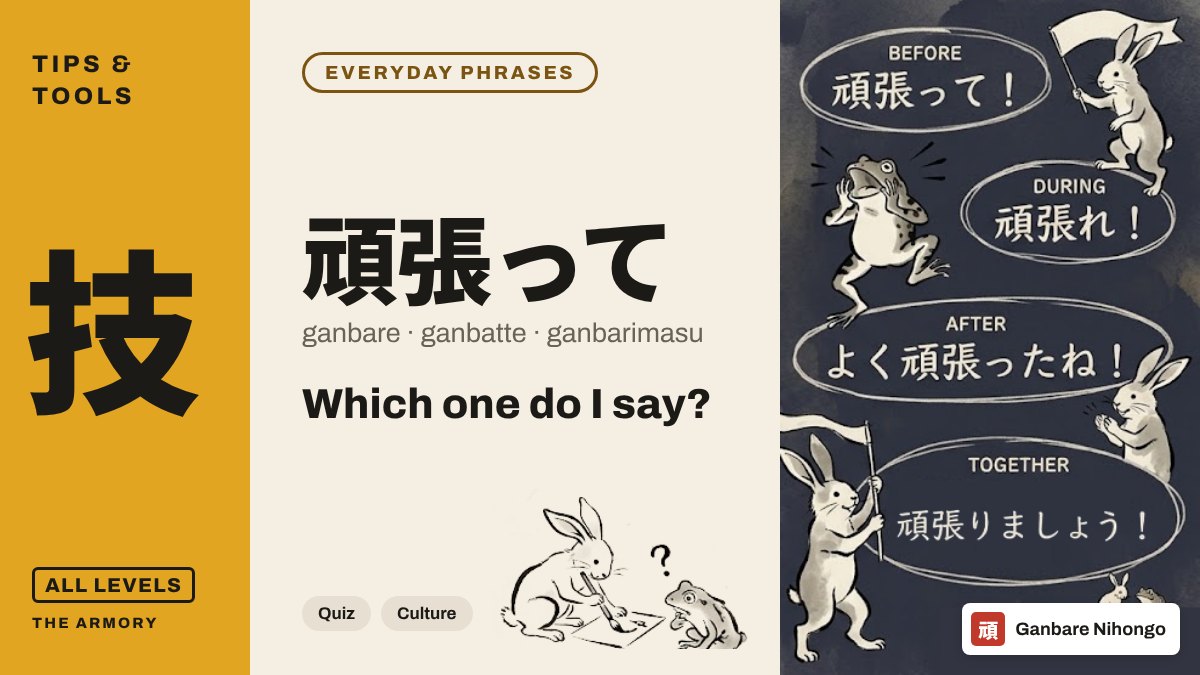
You hear ganbatte in anime, in sports and at school. But Japanese people also say ganbare, ganbarimasu and ganbatta ne. They all come from the same verb, but you use them in different situations.
Contents
The short answer
| Japanese | Who does it? | When | Feeling |
|---|---|---|---|
| 頑張ってがんばって · ganbatte | the other person | before | “Do your best!” (friendly) |
| 頑張ってくださいがんばって ください · ganbatte kudasai | the other person | before | polite |
| 頑張れがんばれ · ganbare | the other person | during | “Come on! Go!” (strong) |
| 頑張りますがんばります · ganbarimasu | me | before | “I’ll do my best.” |
| 頑張りましょうがんばりましょう · ganbarimashou | us | before | “Let’s do our best.” |
| 頑張ったねがんばったね · ganbatta ne | the other person | after | “You did great.” |
Ganbatte and ganbare are for other people, ganbarimasu is for yourself, and ganbatta is for after the hard work is done.
The base verb: 頑張る (ganbaru)
All of these words come from 頑張る(がんばる). It means “to try hard,” “to keep going” or “to not give up.” It is an u-verb.
Notice that ganbaru is about effort, not luck. In English, people often say “Good luck!” before a test. In Japanese, people say “Do your best!” The focus is on what you can control.
That is why ganbatte is not a perfect translation of “good luck.” It is closer to “You can do it!” or “Hang in there!”
Ganbatte: “Do your best!”
頑張って(がんばって) is the te-form of ganbaru. It is a short way of saying 頑張ってください (please do your best). You learned this pattern in GENKI Lesson 6.
Use it before something difficult: a test, a job interview, a game or a speech. It is friendly and warm, so it is perfect for friends, classmates and family.
Adding ね makes it softer and kinder. See sentence-ending particles for more.
Ganbatte kudasai: the polite version
頑張ってください is polite. You can use it with people you don’t know well, or with someone younger at work.
But be careful with your boss or your teacher. 頑張ってください can sound a little like you are giving them an order. Many Japanese people say this instead:
Ganbare: “Come on! Go for it!”
頑張れ(がんばれ) is the command form of ganbaru. It sounds strong and full of energy.
You hear it most during the action: people shout it at marathons, soccer games and school sports days.
Because it is a command, use it with close friends, family, teammates or people younger than you. Don’t say it to your boss.
You can also say it to yourself. When you are tired, you can think 「頑張れ、私!」 (Come on, me!).
Why this site is called “Ganbare Nihongo”
I named this site Ganbare Nihongo because I want to cheer for you while you study. Learning Japanese is a long race, like a marathon. Ganbare is what people shout from the side of the road, so I hope this site feels like that voice for you.
Ganbarimasu: “I’ll do my best.”
頑張ります(がんばります) is about you. It is a promise: “I will try hard.”
It is also the natural answer when someone says ganbatte to you.
Japanese people also say ganbarimasu at the end of a self-introduction at a new job or school. It shows you are motivated. With friends, use the casual form: 頑張る! (I’ll do it!).
Ganbarimashou: “Let’s do our best.”
頑張りましょう includes you and the other person. A team captain or a teacher might say it to the group. The casual form is 頑張ろう!, which is the volitional form. See GENKI Lesson 15 for how to make it.
After the event: Ganbatta ne and Otsukaresama
When the test or the game is over, don’t say ganbatte. The effort is already finished. Use the past form instead (see GENKI Lesson 9 for the た form).
This is kind even when the result was bad. In Japanese, the effort itself is something to praise.
At work, people often say お疲れさまです(おつかれさまです) after a long day or a big project. It means something like “Thank you for your hard work.”
| Timing | What to say |
|---|---|
| Before | 頑張って!がんばって! |
| During | 頑張れ!がんばれ! |
| After | よく頑張ったね! / お疲れさま!よく がんばったね! / おつかれさま! |
When not to say ganbatte
Ganbatte is usually kind. But sometimes it can hurt.
Imagine a friend who is already working very hard, or who is sick, tired or very sad. If you say “Do your best!”, they may feel “I’m already doing my best. I can’t do more.” In Japan, many people know this feeling, so they choose softer words in these moments.
| Situation | Try this instead |
|---|---|
| Someone is very tired or busy | 無理しないでね。むりしないでね。Don’t push yourself too hard. |
| Someone is sick | お大事に。おだいじに。Take care. |
| Someone is sad or worried | 大丈夫?だいじょうぶ?Are you OK? |
| Someone older or higher than you | 応援しています。おうえん して います。I’m cheering for you. |
A good rule: say ganbatte when the person is about to start something. When they are already struggling, show that you care instead.
Quick check: 5 questions
Choose the best word for each situation.
What’s next
- GENKI Lesson 6: the te-form and てください
- GENKI Lesson 15: the volitional form (頑張ろう)
- Sentence-ending particles: why 頑張ってね sounds so warm
My favorite: 頑張りましょう
To be honest, my favorite is 頑張りましょう (Let’s do our best). 頑張ってね is kind, but it can feel a little like “You go and try hard” — the other person is on their own. 頑張りましょう says “We are doing this together.”
That’s how I feel about your Japanese study, too. You are not alone. 一緒に頑張りましょう!
Practice speaking with a real teacher
Want to try these phrases in a real conversation? On italki, you can find a Japanese teacher and book a short trial lesson. Tell them about your goal, and they will say 頑張りましょう!
This is an affiliate link. If you book a lesson, I may earn a small commission at no extra cost to you.