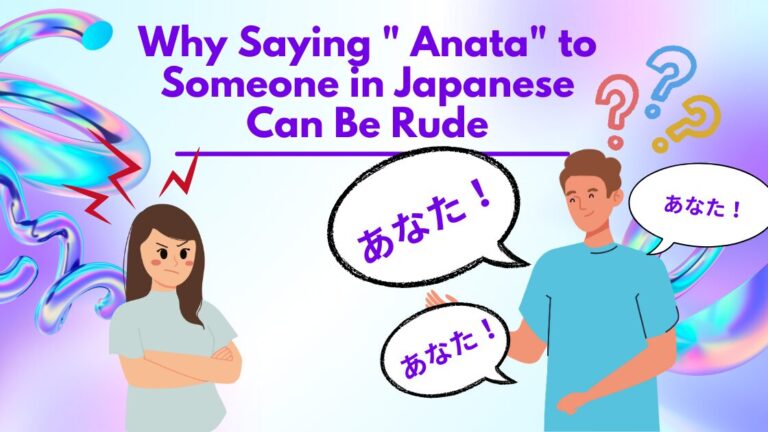
One of the first Japanese words many learners see for “you” is あなた (anata). Textbooks use it, apps use it, and it looks like the perfect match for English “you.” But in real conversation, Japanese people say it much less than you might expect. Used at the wrong time, anata can sound cold, rude, or strangely romantic.
In this guide, you will learn why anata can cause problems, five natural ways to say “you” instead, and the few situations where anata is fine. Every example has audio, so you can hear how it sounds.
Short answer: is anata rude?
Anata is not a bad word. It is grammatically correct, and you will see it in tests, forms, songs and textbooks. The problem is who you say it to and how. When you speak directly to a person, Japanese speakers usually use their name or simply leave out “you.” So a learner who says anata again and again can sound distant, or even a little rude.
4 reasons anata can sound strange
1. It can sound like you are talking down
In modern Japanese, anata is used for people at the same level or lower. Saying it to a teacher, a boss, or an older person can sound like you are speaking to them from above. That is why you mostly see it in written questions, such as tests and surveys, where the writer is not talking to one real person.
あなたの考えを教えてください。
Please tell us your opinion. (a typical test or survey question)
2. It can sound too intimate
For a long time, wives called their husbands あなた, a little like “dear” or “honey.” You can still hear this in older dramas and anime. Because of this image, saying anata to someone you just met can feel oddly personal.
あなた、今日は何時にお帰りですか?
Dear, what time will you be home today? (an old-fashioned way a wife might speak)
3. It can sound like blame
When someone is angry, anata can feel like pointing a finger at the other person. Some people only say anata during an argument.
あなたは、いつもそうやって怒るよね。
You always get angry like that, don’t you.
4. Japanese people rarely need it
In English, almost every sentence needs a subject. Japanese is different. When it is clear who you are talking to, you can drop “you” completely. Adding anata to every sentence sounds like a translation from English, not natural Japanese.
5 natural ways to say “you” in Japanese
1. Leave “you” out
This is the most common choice. If the person in front of you is the only possible “you,” you do not need to say it.
| With anata (unnatural) | Without anata (natural) | Meaning |
|---|---|---|
| あなたはどこから来ましたか? | どこから来ましたか? | Where are you from? |
| あなたの名前はなんですか? | 名前はなんですか? | What is your name? |
| あなたはどう思いますか? | どう思いますか? | What do you think? |
| あなたは今日、学校へ行きましたか? | 今日、学校へ行きましたか? | Did you go to school today? |
2. Use the person’s name
If you know the person’s name, use it. In Japanese, using someone’s name where English uses “you” is normal and polite.
- 田中さん、お元気ですか? How are you, Mr./Ms. Tanaka?
- 鈴木さんは、どう思いますか? What do you think, Suzuki-san?
- 佐藤さん、今日、学校へ行きましたか? Did you go to school today, Sato-san?
3. Add the right name ending
When you use a name, add an ending that fits the person and your relationship.
| Ending | Who it is for | Example |
|---|---|---|
| 〜さん | Almost anyone. The safe choice for men and women of any age. | 田中さん、こんにちは! |
| 〜様(さま) | Customers and people you show special respect to. | 田中様、お待ちしておりました。 |
| 〜くん | Boys and younger men, often used by teachers, bosses or close friends. | 田中くん、今日の宿題おわった? |
| 〜ちゃん | Children, close friends and family. Added to the first name. | ゆかちゃん、貸してくれてありがとう。 |
〜さん
〜様
〜くん
〜ちゃん
4. Use a title or role
For teachers, doctors, bosses and shop customers, Japanese people often use the title instead of a name. A title alone is already polite, so you do not add 〜さん to 先生.
- 先生、おはようございます。 Good morning, teacher.
- 部長、今日の会議はどこでしましょうか。 Where shall we have today’s meeting? (to your department manager)
- ちょっとお客さん、忘れ物ですよ。 Excuse me, you forgot something! (to a customer)
5. Start with すみません when you don’t know the person
With a stranger, you don’t need a word for “you” at all. Start with すみません (excuse me) to get their attention, then ask your question.
すみません、駅はどこですか?
Excuse me, where is the station?
When is it OK to use anata?
Anata is not forbidden. It is natural in these situations:
- Songs and poems. Many Japanese love songs use あなた because it sounds soft and emotional.
- Tests, surveys and ads. Writing that speaks to “everyone,” such as あなたにぴったりのプラン (a plan that’s perfect for you).
- When you don’t know the name and must point to one person. Use it softly, and add すみません first.
あの、すみません、あなたに話してるんですけど。
Um, excuse me, I’m talking to you.
You may also hear an older woman say something like the example below. It sounds friendly but a little old-fashioned.
ちょっとあなた、なにかついているわよ。
Hey, you’ve got something on you.
Quick check
How would you say these naturally? Click to see the answer.
1. You want to ask your teacher, “Did you see my homework?”
先生、宿題を見ましたか? Use the title 先生, not あなた.
2. You meet a new classmate and want to ask where they are from.
どこから来ましたか? Just leave out “you.”
3. You want to ask a stranger on the street where the station is.
すみません、駅はどこですか? Start with すみません.
Summary
- あなた is correct Japanese, but in conversation it can sound distant, too intimate, or like blame.
- Most of the time, leave out “you,” or use the person’s name with 〜さん.
- Use titles like 先生 for teachers and bosses, and start with すみません for strangers.
- あなた is natural in songs, tests, ads and written questions.
Want to see how this works in basic sentences? In GENKI Lesson 1, you learn the pattern XはYです, where the textbook still uses あなた. Now you know when to keep it and when to drop it.
Practice speaking naturally with a teacher
Knowing the rule is one thing. Using it in real conversation is another. The best practice is to talk with a real Japanese teacher. On italki, you can find a teacher who fits your level and book a short trial lesson.
The italki link is an affiliate link. If you book a lesson, I may earn a small commission at no extra cost to you.