Kiru vs Karu vs Soru (きる vs かる vs そる / 切る・刈る・剃る): Cut, Mow and Shave in Japanese
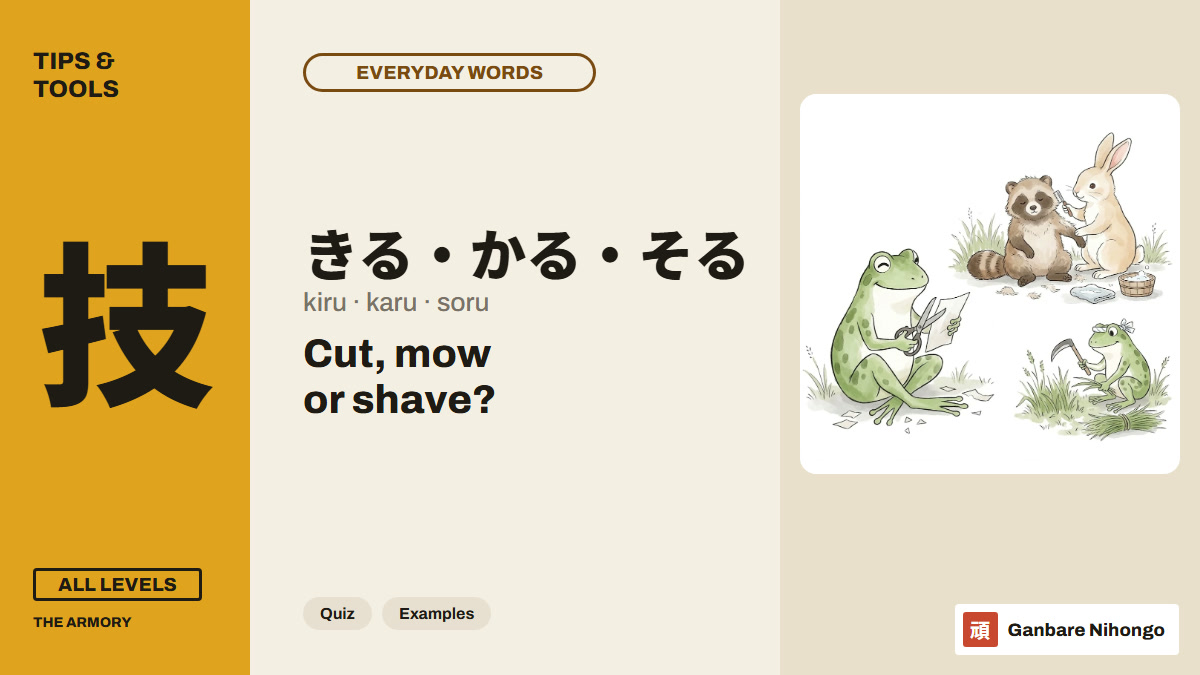
“I cut the grass.” “I got my hair cut.” “I shaved.” In English, “cut” can do a lot of work. In Japanese, you need three different verbs: 切る (kiru), 刈る (karu) and 剃る (soru). That can be confusing, so here is a simple guide.
Contents
The short answer
| Verb | What you do | Tool | Examples |
|---|---|---|---|
| 切るkiru | cut something into pieces or cut part of it off | knife, scissors, saw | 木・髪・野菜・つめ |
| 刈るkaru | cut many short things evenly, close to the surface | mower, clippers, sickle | 草・しばふ・髪 |
| 剃るsoru | shave hair off completely, at the skin | razor | ひげ・顔・頭 |
切る = cut (the general word). 刈る = cut a whole surface short, like a lawn. 剃る = shave to the skin. Think of how much is left: 切る (you choose), 刈る (a little), 剃る (nothing).
切る: the general word for “cut”
切る is the word you will use most. You cut one thing with a knife, scissors or a saw.
Careful: 切る looks like a る-verb, but it is an う-verb. 切ります, 切って, 切らない. (着る “wear” is the る-verb: 着ます, 着て.)
Also, 切る is used for many things that are not about knives: 電話を切る (hang up), 電源を切る (turn off the power), and 水を切る (drain water).
刈る: grass, crops and short hair
刈る means cutting a whole area of short things so they become even: grass, a lawn, rice plants, or hair with clippers. It is also an う-verb (刈ります, 刈って).
You will often see it in nouns:
| Word | Meaning |
|---|---|
| 草刈りkusakari | cutting grass, weeding with a mower or sickle (a common community job in Japan) |
| 稲刈りinekari | rice harvest |
| 丸刈りmarugari | a buzz cut: very short hair all over, cut with clippers |
| 刈り上げkariage | short back and sides, an undercut |
Trees are different. You 切る a tree (cut it down) or a branch. But for a hedge, you can 刈る it to make it even: 生け垣を刈る.
剃る: shave
剃る means shaving hair off at the skin with a razor. Nothing is left. The kanji 剃 is difficult and not common, so you will usually see it in hiragana: そる. It is an う-verb too (そります, そって).
At many Japanese barbers (床屋), a haircut comes with a face shave: 顔そり. Not only men! Some women go to a barber or a beauty salon just for 顔そり, to remove the soft hair on their face.
Hair: 切る, 刈る or 剃る?
Hair is where all three verbs meet, so this is the confusing part. It depends on how much is left.
| Sentence | What happened |
|---|---|
| 髪を切った。 | a normal haircut with scissors (any length) |
| 髪を短く刈った。 | clippers, very short and even |
| 丸刈りにした。 | a buzz cut (you can still see the hair) |
| 頭をそった。 | shaved bald, nothing left |
丸刈り and 坊主 (a monk’s style) are words you hear a lot in Japan, especially for boys on high school baseball teams.
Why do Japanese people say 「髪を切った」?
When you go to a hair salon, someone else cuts your hair. So learners often say 「髪を切ってもらいました」. This is correct, but Japanese people usually just say:
Everyone knows a hairdresser did it. In the same way, you can say 家を建てた (I built a house) when a builder did the work. Use 切ってもらった when you want to say who did it: 「母に髪を切ってもらった」.
Beards: 切る or 剃る?
「ひげを切る」 is not wrong, but it sounds like cutting it with scissors. For a neat trim, 整える is the natural word.
Quick check: 5 questions
Choose the best answer.
Getting a haircut in Japan?
Japanese barbers and hair salons are famous for their careful work (and the head massage!). Start with simple phrases like 「みじかく してください」 (Short, please). My Travel Japanese Pack teaches the phrases you will really use at stations, restaurants, shops and hotels: 12 short lessons with an illustrated PDF and native audio.
What’s next
Practice with a real teacher
Word pairs like these are easier to remember when you use them in a real conversation. On italki, you can book a short trial lesson with a Japanese teacher and ask, “Is this natural?”
This is an affiliate link. If you book a lesson, I may earn a small commission at no extra cost to you.