JLPT N4 Reading: 注文の多い料理店 (The Restaurant of Many Orders) in Easy Japanese
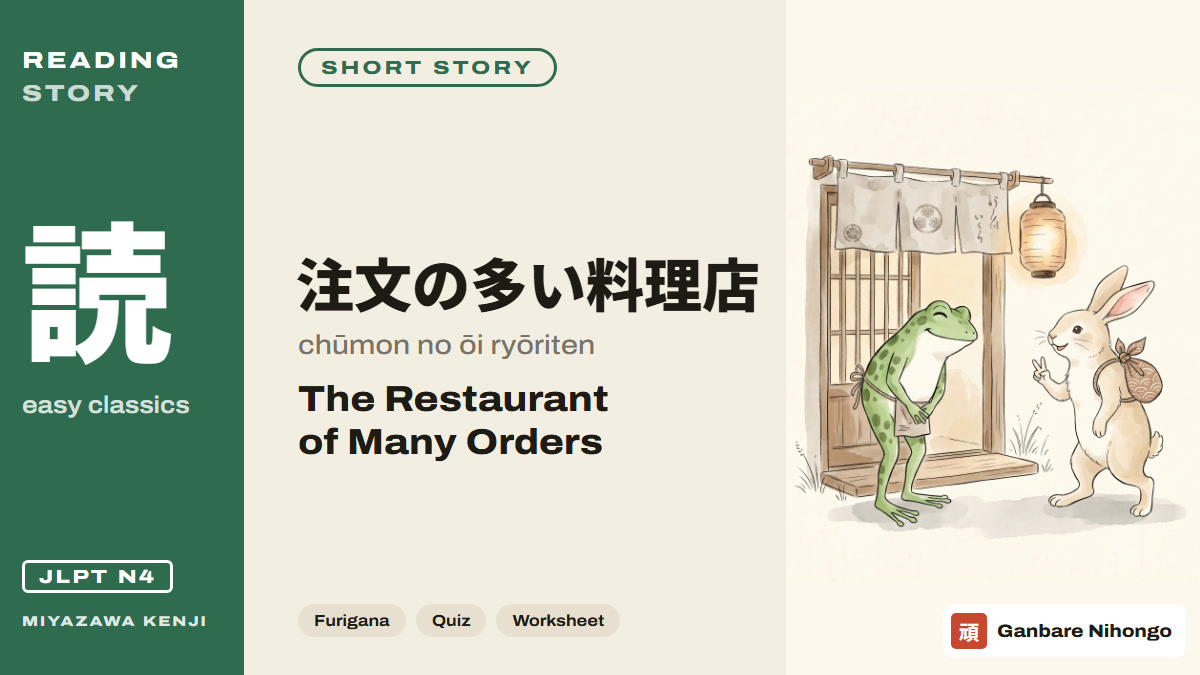
Two rich young men go hunting in the mountains. They get lost, they are very hungry, and then they find a nice Western restaurant in the middle of the forest. At every door there is a sign with a request: “Please take off your coat.” “Please put this cream on your face.” Hmm… why?
This is 注文の多い料理店 (chūmon no ōi ryōriten, “The Restaurant of Many Orders”), a famous short story by Miyazawa Kenji (宮沢賢治, 1896–1933). It came out in 1924, and almost every Japanese person reads it at school. I rewrote it in easy Japanese for JLPT N4, so you can enjoy it now, not “someday”.
- Level: JLPT N4 (around the end of GENKI II)
- Two short parts. Every kanji has furigana
- Key words, two quizzes, the grammar in the story, and a free printable worksheet
Read Part 1, and stop. Guess what happens next. Then read Part 2. The story has a trick, and it is much more fun when you find it yourself!
Contents
Key words
You don’t need to remember them all. Just look at them once before you read.
| Japanese | Meaning |
|---|---|
| 狩り | hunting |
| 鉄砲 | gun |
| 猟師 | hunter (here, their guide) |
| 目を回す | to get dizzy and faint |
| 大損 | a big loss (of money) |
| 西洋風 | Western-style |
| 大かんげい | very welcome |
| 注文 | ① an order (at a restaurant) ② a request, a demand |
| ご了承ください | please understand (polite, on signs) |
| 金物 | metal things |
| とがった物 | sharp things |
| 香水/お酢 | perfume / vinegar |
| もみこむ | to rub in |
| かぎあな | keyhole |
| 紙くず/くしゃくしゃ | scrap paper / crumpled |
Part 1(前半)
二人の若い男の人が、山へ狩りに来ました。二人とも東京のお金持ちで、新しい鉄砲を持って、大きい白い犬を二匹連れていました。
でも、山の中をいくら歩いても、鳥も動物もいません。
「つまらないなあ。早く何かうちたいよ。」
そのうちに、道を案内してくれた猟師が、どこかへ行ってしまいました。それから、二匹の犬も目を回して、倒れてしまいました。
「この犬は高かったのに。大損だ。」
一人は、犬のことより、お金のことを心配していました。
風がどうっと吹いて、木の葉がかさかさ鳴りました。二人はおなかがすいて、もう帰りたくなりました。でも、帰る道がわかりません。そのとき、うしろに立派な西洋風の家が見えました。
西洋料理店
WILDCAT HOUSE
山猫軒
「ちょうどいい。何か食べよう。」
ドアには、こう書いてありました。
二人はよろこんで中に入りました。すると、次のドアに金色の字で、こう書いてありました。
「ぼくたちは両方だね。」二人はもっとよろこびました。
次のドアには、こう書いてありました。
「注文が多いのは、人気があるからだろう。」
“A restaurant of many orders.” What do you think will happen next? Make a guess before you read Part 2.
Part 2(後半)
でも、ドアはまだまだ続きました。
鉄砲はここに置いてください。
ぼうしとコートとくつをぬいでください。
「えらい人が来ているのかな。」
「料理に電気を使うから、金物はあぶないんだろう。」
「外は寒いから、はだを守るためだね。」
二人はクリームをぬりました。一人は、こっそり少し食べてしまいました。
でも、その香水は、なんだかお酢のようなにおいがしました。最後のドアには、こう書いてありました。
二人は顔を見合わせました。
「おかしいよ。注文が多いっていうのは、ぼくたちが注文するんじゃなくて……」
「ぼくたちが食べられるんだ!」
二人はがたがたふるえて、声も出ません。うしろのドアは開きません。前のドアのかぎあなから、青い目が二つ、こちらを見ています。
「いらっしゃい、いらっしゃい。サラダがおきらいなら、フライにしてあげましょうか。」
二人はあまりこわくて、泣いてしまいました。顔は紙くずのように、くしゃくしゃになりました。
そのとき、「ワン!」と声がして、あの白い犬が二匹、ドアをやぶって入ってきました。犬は元気になっていたのです。部屋は真っ暗になって、家はけむりのように消えてしまいました。
気がつくと、二人は草の上に立っていました。コートやくつやさいふは、木の枝にかかっていました。そこへ猟師がもどってきました。二人は鳥を買って、東京へ帰りました。
でも、紙くずのようになった二人の顔は、東京に帰っても、おふろに入っても、もう元にもどりませんでした。
The trick: two meanings of 注文
The word 注文 has two meanings. Usually it means an order at a restaurant: ラーメンを注文する (to order ramen). But it can also mean a request or a demand: 注文が多い人 (a person who asks for many things, a fussy person).
When the two men read 「注文の多い料理店」, they think: “Many customers order here. It must be popular!” But the restaurant means: “We will give you many requests.” Cream, perfume, salt… The men are not the customers. They are the food.
When the dogs fall down, one man says 「この犬は高かったのに。大損だ。」 He worries about money, not about his dogs. Miyazawa Kenji did not like people like this. Maybe that is why their faces never go back to normal.
Grammar in the story
| Grammar | From the story | Meaning |
|---|---|---|
| 〜てあります | ドアに こう書いてありました。 | Something is written (someone wrote it) |
| 〜てしまう | 犬も 倒れてしまいました。 | It happened (and that’s bad / I didn’t want it) |
| 〜のに | この犬は 高かったのに。 | Even though… (complaining) |
| 〜だろう | 人気があるからだろう。 | Probably… (casual でしょう) |
| 〜のかな | えらい人が 来ているのかな。 | I wonder if… |
| Passive 〜られる | ぼくたちが 食べられるんだ! | We will be eaten! |
| 〜てあげましょうか | フライにしてあげましょうか。 | Shall I do it for you? |
| 〜ても、〜ても | 帰っても、おふろに 入っても | Even if A, even if B |
| 〜のように | 紙くずのように | Like… |
Talk about it
Try to answer in Japanese. Write your answers, or say them out loud.
- あなたなら、どのドアで「おかしい」と気がつきますか。
- 犬が倒れたとき、お金のことを心配した二人を、どう思いますか。
- どうして二人の顔は、元にもどらなかったと思いますか。
- レストランで「注文が多いな」と思ったことがありますか。
Free worksheet
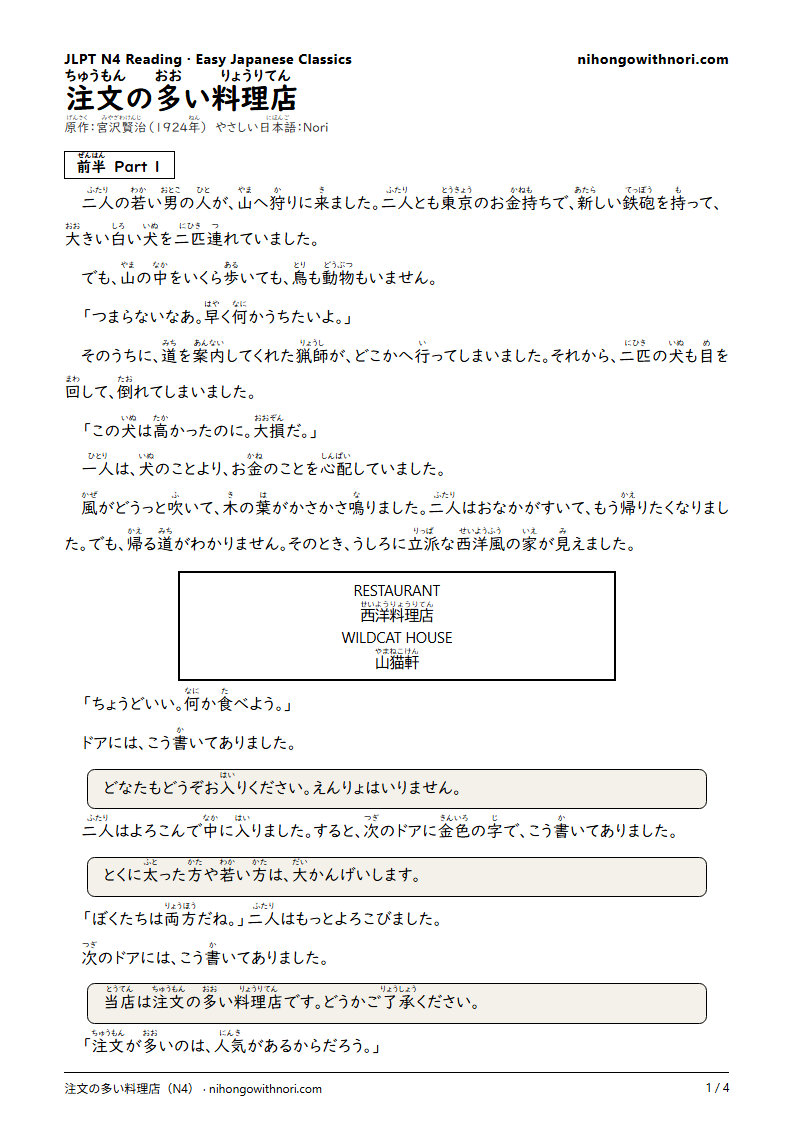
Want to read it on paper? Download the printable version. It has the whole story with furigana, key words, 7 questions, 4 talk questions, and an answer key. Teachers are welcome to use it in class.
About the original story
Miyazawa Kenji wrote this story in 1924. He died in 1933, so the original text is free to read on Aozora Bunko. The Japanese there is old and difficult (around N1), so come back to it when you are ready. The easy Japanese version on this page is my own rewrite.
More N4 reading
Practice speaking with a real teacher
Reading is more fun when you can talk about it. Tell a teacher the story in your own words, and answer the “Talk about it” questions together. On italki, you can find a teacher and book a short trial lesson.
This is an affiliate link. If you book a lesson, I may earn a small commission at no extra cost to you.