Japanese Counters for Beginners: つ・人・本・枚・匹 and the Easy Sound Rule (Bonus Step ☆)
You have three pencils. How do you say it in Japanese: さんほん or さんぼん? The answer is さんぼん. In Japanese, the way you count changes with the thing you count. And sometimes the sound changes, too.
That sounds hard, but don’t worry. The rules are very simple. This page is a bonus step in my grammar series. Textbooks teach counters little by little, so here they are all in one place: the 7 counters you really need, the easy sound rule, and more counters to know for JLPT N4.
- What a counter is, and where the number goes in a sentence
- The two ways to count: ひ・ふ・み and いち・に・さん
- The 7 counters for everyday life: つ, 人, 枚, 冊, 本, 匹, 杯
- The sound-change rule: いっぽん, さんぼん, ろっぽん
- Why people say よん and なな, and the old numbers in dates
- Real Japanese at shops and restaurants: 何名様ですか and 個
- More counters to know for JLPT N4
Contents
- Start with the vocabulary
- What is a counter?
- Two ways to count: ひ・ふ・み and いち・に・さん
- つ: you can use it for almost anything
- 人: people
- 枚: thin, flat things
- 冊: books and notebooks
- 本: long, thin things
- 匹: small animals
- 杯: cups and glasses
- The sound-change rule
- Number tip 1: why よん and なな?
- Number tip 2: the old numbers are still alive in dates
- Common mistakes
- Real Japanese: at shops and restaurants
- The answer: how to count rabbits
- More counters to know for JLPT N4
- Summary
- Final check: 10 questions
- Free worksheet
- What’s next
- Practice speaking with a real teacher
Start with the vocabulary
Let’s learn the key words first. You will see them again in the examples below. Say the answer before you flip.
What is a counter?
In English, you say “a piece of paper” or “a cup of coffee”. In Japanese, you always do this. You put a small word after the number. This word is called a counter (助数詞).
The sentence looks like this. The number comes right before the verb, and it has no particle.
Don’t put を after the number. We say りんごを みっつ ください, not りんごを みっつを ください.
There are many counters in Japanese. But for everyday life, the seven on this page are enough.
Two ways to count: ひ・ふ・み and いち・に・さん
Here is something most lessons don’t tell you. Japanese has two sets of numbers.
| Japanese numbers | Chinese-style numbers | |
|---|---|---|
| Sound | ひ・ふ・み・よ…hi, fu, mi, yo… | いち・に・さん・し…ichi, ni, san, shi… |
| Where from | The original Japanese way to count | Came from China, together with kanji |
| Used with | つ: ひとつ, ふたつ, みっつ | 本, 枚, 匹, 杯, 冊: いっぽん, にまい… |
Counters are the same. The words 本, 枚, 匹, 杯 and 冊 all came from Chinese. (Chinese also puts a small word after numbers.) So the basic pairing is:
- Chinese-style counters go with いち・に・さん.
- The Japanese counter つ goes with ひ・ふ・み.
Remember this pairing. It explains many “strange” words later on this page, like ひとり, よにん and ふつか.
How do you count rabbits in Japanese? A rabbit is an animal, so 匹? Actually, there is a funny way to count rabbits. The answer is near the end of this page.
つ: you can use it for almost anything
First, the most useful counter: つ. You can use it for almost any thing: apples, cakes, chairs, even questions and ideas.
- つ goes only up to ten. From eleven, just say the number: じゅういち, じゅうに.
- Ten is とお. There is no つ.
- To ask “how many?”, say いくつ.
When you are not sure, use つ. It may not be the perfect counter, but people will understand you. (Only people and animals are different: don’t use つ for them.)
人: people
To count people, use 人(にん). But one and two are special: ひとり and ふたり.
- Four people is よにん, not よんにん.
- Seven people can be ななにん or しちにん. Both are OK.
- To ask, say なんにん.
Why are only ひとり and ふたり different?
The answer is the two number sets. ひとり and ふたり are the Japanese numbers ひ and ふ plus り, an old word for counting people.
Long ago, people also said みたり for three people and よたり for four. You can still see these words in old books. But over time, from three people, the Chinese-style さんにん took over. Only the very common ひとり and ふたり stayed.
The よ in よにん is also a Japanese number. That is why we don’t say よんにん.
枚: thin, flat things
枚(まい) is for thin, flat things: paper, T-shirts, stamps, tickets, plates, pizza.
The sound never changes. Easy! To ask, say なんまい.
冊: books and notebooks
冊(さつ) is for books, notebooks and magazines.
One, eight and ten get a small っ: いっさつ, はっさつ, じゅっさつ. Six is just ろくさつ.
本: long, thin things
本(ほん) is for long, thin things: pencils, pens, umbrellas, bottles, bananas, trees.
There are three sounds: ぽん・ほん・ぼん. The さんぼん from the first question is here.
本 means “book”, but you don’t count books with 本. Books are 冊: ほんを いっさつ. The counter 本 is for long things.
匹: small animals
匹(ひき) is for small animals: cats, dogs, fish, insects.
It is the same pattern as 本: ぴき・ひき・びき.
杯: cups and glasses
杯(はい) is for drinks in a cup or a glass. You can also use it for bowls of rice or ramen.
The same pattern again: ぱい・はい・ばい.
The sound-change rule
Now let’s put the rule together. Take a screenshot of this table.
| 本 ほん | 匹 ひき | 杯 はい | 冊 さつ | |
|---|---|---|---|---|
| 1 | いっぽん | いっぴき | いっぱい | いっさつ |
| 3 | さんぼん | さんびき | さんばい | さんさつ |
| 6 | ろっぽん | ろっぴき | ろっぱい | ろくさつ |
| 8 | はっぽん | はっぴき | はっぱい | はっさつ |
| 10 | じゅっぽん | じゅっぴき | じゅっぱい | じゅっさつ |
| How many? | なんぼん | なんびき | なんばい | なんさつ |
- 1, 6, 8, 10 get a small っ: いっ, ろっ, はっ, じゅっ.
- With 本・匹・杯, the sound then becomes ぽ・ぴ・ぱ: いっぽん, ろっぴき, はっぱい.
- 3 and なん (how many) become ぼ・び・ば: さんぼん, なんびき, なんばい.
The other numbers (2, 4, 5, 7, 9) don’t change: にほん, よんほん, ごほん, ななほん, きゅうほん.
You may also hear はちほん for 8 and じっぽん for 10. Those are fine, too. In everyday speech, はっぽん and じゅっぽん are the most common.
Number tip 1: why よん and なな?
Four can be し and seven can be しち. But when people count, they often say よん and なな. These two come from the Japanese numbers (よ, なな). Why are they so popular? There are two common reasons.
- し sounds the same as 死 (death). Some hospitals and hotels don’t have a room number 4.
- しち is easy to mishear as いち. With phone numbers, なな causes fewer mistakes.
So with counters, use よん and なな: よんほん, ななまい, よんひき. (Remember the special ones: よにん, and よっつ.)
Number tip 2: the old numbers are still alive in dates
The old ひ・ふ・み numbers are still alive in the days of the month. Look at the sounds. They are like ふたつ, みっつ, よっつ.
| Number | With つ | Day of the month |
|---|---|---|
| 2 | ふたつ | ふつかfutsuka (the 2nd) |
| 3 | みっつ | みっかmikka (the 3rd) |
| 4 | よっつ | よっかyokka (the 4th) |
| 5 | いつつ | いつかitsuka (the 5th) |
| 6 | むっつ | むいかmuika (the 6th) |
| 7 | ななつ | なのかnanoka (the 7th) |
| 8 | やっつ | ようかyooka (the 8th) |
| 9 | ここのつ | ここのかkokonoka (the 9th) |
| 10 | とお | とおかtooka (the 10th) |
Two more old numbers: the 20th is はつか, and 20 years old is はたち. (The 1st is special: ついたち.) Learn ふたつ and ふつか together, and dates get much easier.
Common mistakes
| Wrong | Right | Why |
|---|---|---|
| ににん | ふたり | One and two people are special. |
| よんにん | よにん | よ is the Japanese number. |
| いちほん | いっぽん | 1 gets a small っ, and ほ becomes ぽ. |
| さんほん | さんぼん | After 3, ほ becomes ぼ. |
Real Japanese: at shops and restaurants
何名様ですか
When you enter a restaurant, the staff will ask なんめいさまですか (How many people?). 名(めい) is a polite way to count people. The staff use it for customers.
You don’t need to use 名 for yourself. Just answer with ひとり, ふたり, さんにん. Many people show the number with their fingers, too.
個: the counter Japanese people really use
Beginner lessons often start with つ, but Japanese people also use 個(こ) a lot: りんご さんこ, たまご にこ. You can use it for most small things. And unlike つ, it does not stop at ten: じゅういっこ, にじゅっこ.
Watch the small っ: いっこ, ろっこ, はっこ, じゅっこ. To ask, say なんこ.
Ordering is easy with つ
In real conversation, people often drop を when they order.
The answer: how to count rabbits
Now, the answer to the mystery. Rabbits are sometimes counted with 羽(わ): いちわ, にわ. 羽 is the counter for birds!
Nobody knows exactly why. One popular story: long ago, when people were not supposed to eat four-legged animals, they said that rabbits were “birds”. Another story says that their long ears look like wings.
Today, いっぴき, にひき is normal for rabbits. But if you say いちわ, Japanese people will say, “Wow, you know a lot!”
More counters to know for JLPT N4
You know the seven basic counters now. Here are more counters that you will often see and hear at the JLPT N4 level. You don’t need to learn them all today. Come back to this table when you meet them.
Things, places and animals
| Counter | What it counts | Watch the sound |
|---|---|---|
| 個 | small things (eggs, apples, boxes) | いっこ, ろっこ, はっこ, じゅっこ |
| 台 | machines, cars, bikes, computers | No change: いちだい, にだい |
| 階 | floors of a building | いっかい, さんがい, ろっかい, はっかい, じゅっかい, なんがい |
| 軒 | houses, shops, restaurants | いっけん, さんげん, ろっけん, はっけん, じゅっけん |
| 足 | pairs of shoes and socks | いっそく, さんぞく, はっそく, じゅっそく |
| 着 | clothes (suits, coats, dresses) | いっちゃく, はっちゃく, じゅっちゃく |
| 頭 | big animals (cows, horses, elephants) | いっとう, はっとう, じゅっとう |
| 羽 | birds (and sometimes rabbits) | いちわ, にわ, さんわ |
Time and how long
| Counter | What it counts | Watch the sound |
|---|---|---|
| 時 | o’clock | よじ, しちじ, くじ |
| 分 | minutes | いっぷん, さんぷん, よんぷん, ろっぷん, はっぷん, じゅっぷん, なんぷん |
| 時間 | hours (how long) | よじかん, しちじかん, くじかん |
| 日 / 日 | days | ふつか, みっか… とおか (the old numbers!). One day is いちにち. |
| 週間 | weeks | いっしゅうかん, はっしゅうかん, じゅっしゅうかん |
| か月 | months (how long) | いっかげつ, ろっかげつ, はっかげつ, じゅっかげつ |
| 年 | years | よねん (not よんねん) |
| 歳 | age | いっさい, はっさい, じゅっさい. 20 is はたち. |
Be careful with 分. It looks like 本, but 3, 4 and なん take ぷ, not ぶ: さんぷん, よんぷん, なんぷん.
How many times, how much, which number
| Counter | What it counts | Watch the sound |
|---|---|---|
| 回 | times (how often) | いっかい, ろっかい, はっかい, じゅっかい |
| 度 | degrees (temperature); times | No change: さんじゅうど. もう いちど = one more time. |
| 円 | yen | よえん (4 yen). ひゃくえん, せんえん. |
| 番 | number (in order) | No change: いちばん, にばん |
| 〜目 | the first, the second… (add it after a counter) | ひとつめ, ふたりめ, さんかいめ |
Look at the first sound of the counter.
- は-line (ほん, ひき, はい, ふん): 1, 6, 8, 10 → っ + ぱ-line. 3 and なん → ば-line (but ふん → ぷん).
- か-line (こ, かい, かげつ, けん): 1, 6, 8, 10 → small っ. いっこ, ろっかい.
- さ-line and た-line (さつ, さい, しゅうかん, そく, ちゃく, とう): only 1, 8, 10 → small っ. いっさい, はっさつ.
- Others (まい, だい, ど, ばん, えん, にん): no sound change.
Summary
Take a screenshot and use it for review.
| Counter | For | 1 | 2 | 3 | How many? |
|---|---|---|---|---|---|
| つ | anything (to 10) | ひとつ | ふたつ | みっつ | いくつ |
| 人 にん | people | ひとり | ふたり | さんにん | なんにん |
| 枚 まい | flat things | いちまい | にまい | さんまい | なんまい |
| 冊 さつ | books | いっさつ | にさつ | さんさつ | なんさつ |
| 本 ほん | long things | いっぽん | にほん | さんぼん | なんぼん |
| 匹 ひき | small animals | いっぴき | にひき | さんびき | なんびき |
| 杯 はい | cups, glasses | いっぱい | にはい | さんばい | なんばい |
- Not sure? Use つ.
- People: ひとり, ふたり, then さんにん, よにん.
- 1, 6, 8, 10: small っ.
- 3 and なん: ぼ・び・ば.
Final check: 10 questions
These questions mix everything on this page. Get 8 or more right, and you can count in Japanese!
Free worksheet
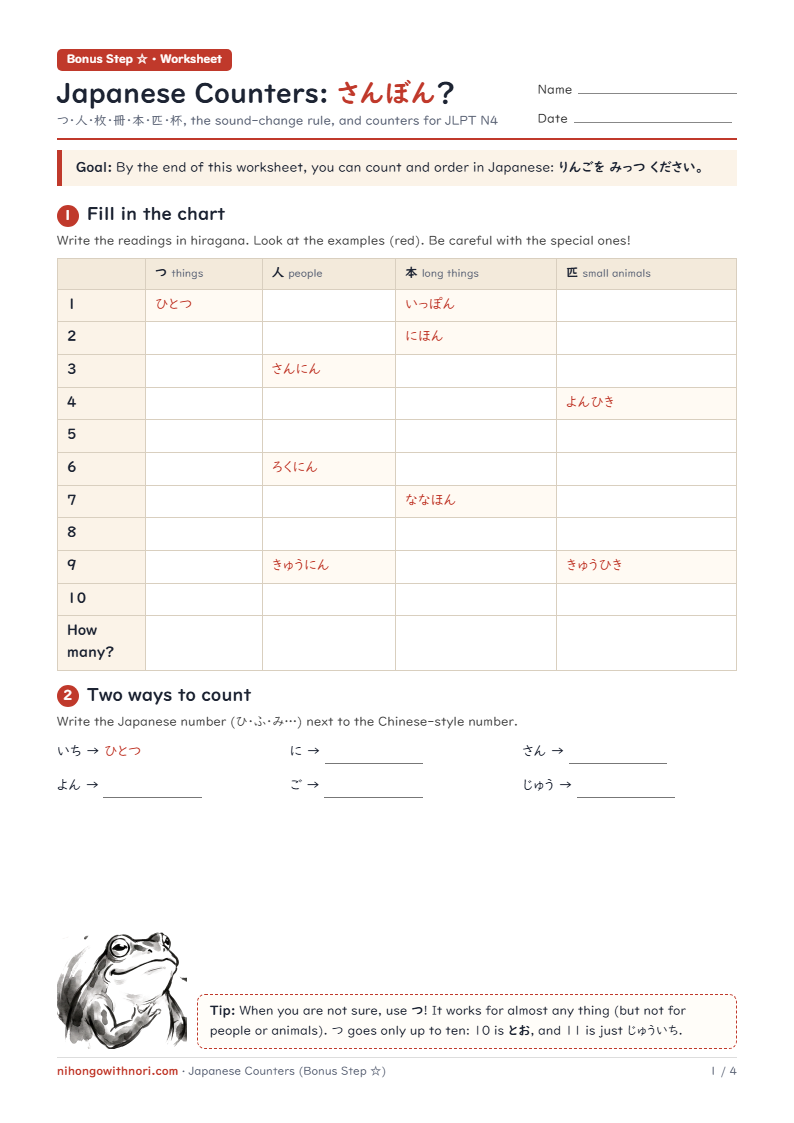
Want to practice writing? Download the printable counters worksheet. It has a counting chart, “which counter?”, the sound-change rule, “find the mistake”, a restaurant conversation, the old numbers in dates, N4 counters, and an answer key.
What’s next
- Step 7: the te-form, てください and てもいいですか
- Step 6: い-adjectives and な-adjectives
- Step 1: numbers in phone numbers and telling the time
Practice speaking with a real teacher
Counters get easy when you say them out loud. Tell a teacher about your room: ほんが じゅっさつ あります。ねこが いっぴき います。 On italki, you can find a teacher and book a short trial lesson.
This is an affiliate link. If you book a lesson, I may earn a small commission at no extra cost to you.