Japanese Sonkeigo: Honorific Verbs like いらっしゃる (GENKI Lesson 19)
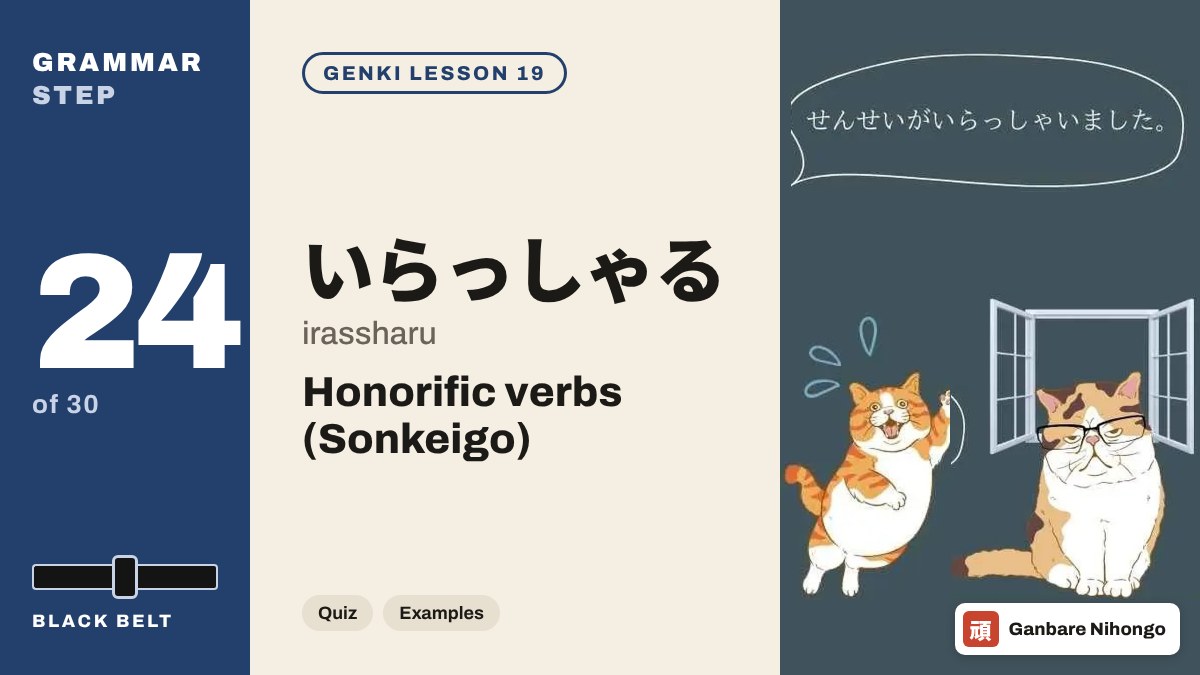
Sonkeigo (尊敬語) is respectful language. You use it to talk about the actions of people above you: teachers, bosses, customers, or someone you just met. It raises the other person. You learn it in GENKI Lesson 19.
Its partner, kenjōgo (humble language), lowers your own actions. See Kenjōgo after this lesson.
- Special honorific verbs: いらっしゃる, なさる, 召し上がる …
- The regular pattern: お + stem + になる
- Respectful requests: お〜ください and 〜てくださる
- When to use sonkeigo, and when not to
Contents
Start with the vocabulary
Let’s learn the key words from this lesson first. You will see them again in the examples below. Say the answer before you flip. Turn the readings off to test yourself.
Special honorific verbs
The most common verbs have their own honorific form. Learn these first.
| Plain | Sonkeigo | Example |
|---|---|---|
| いる / 行く / 来る | いらっしゃるいらっしゃる | 先生は研究室にいらっしゃいますか。せんせいは けんきゅうしつに いらっしゃいますか。 (Is the professor in her office?) |
| する | なさるなさる | 週末は何をなさいますか。しゅうまつは なにを なさいますか。 (What will you do this weekend?) |
| 食べる / 飲む | 召し上がるめしあがる | どうぞ召し上がってください。どうぞ めしあがって ください。 (Please help yourself.) |
| 言う | おっしゃるおっしゃる | 先生がそうおっしゃいました。せんせいが そう おっしゃいました。 (The teacher said so.) |
| 見る | ご覧になるごらんになる | この写真をご覧になりましたか。この しゃしんを ごらんに なりましたか。 (Have you seen this photo?) |
| 寝る | お休みになるおやすみになる | 部長はもうお休みになりました。ぶちょうは もう おやすみに なりました。 (The manager has gone to bed.) |
| 知っている | ご存じだごぞんじだ | 田中先生をご存じですか。たなかせんせいを ごぞんじですか。 (Do you know Professor Tanaka?) |
| くれる | くださるくださる | 社長がアドバイスをくださいました。しゃちょうが アドバイスを くださいました。 (The president gave me advice.) |
いらっしゃる, なさる, おっしゃる and くださる have a special ます form: いらっしゃいます, なさいます, おっしゃいます, くださいます (not いらっしゃります).
The regular pattern: お + stem + になる
For most other verbs, take the ます stem and put it between お and になる.
For する-verbs from Chinese words, use ご: ご利用になる (use), ご説明になる (explain).
The passive form (〜れる / 〜られる) can also show respect: 先生が書かれた本 (a book the professor wrote). It is a lighter, common style in business and the news.
Respectful requests
お + stem + ください
This is a polite way to ask a customer or guest to do something. You see it on signs everywhere in Japan.
〜てくださる
When a superior does something for you, use 〜てくださる (the respectful 〜てくれる).
When to use sonkeigo
- Use it for the actions of other people who deserve respect: teachers, bosses, customers, older people you don’t know well.
- Never use it for your own actions. ✗ 私はいらっしゃいます → ✓ 私は参ります (humble).
- When you talk to someone outside your company, don’t use sonkeigo for your own boss: 部長の田中は今、外出しております.
- Don’t overdo it. Too many honorifics in one sentence can sound strange.
Shop staff use sonkeigo with you all the time: いらっしゃいませ (welcome) is the imperative of いらっしゃる! Listen for it on your trip with the Travel Japanese Pack.
Final check: 10 questions
Get 8 or more right, and you are ready for kenjōgo.
What’s next
- Kenjōgo: humble language for your own actions
- あげる, くれる and もらう: くださる and いただく
- Is “anata” rude?
Practice speaking with a real teacher
Keigo becomes natural only with practice in real situations. Ask a teacher to role-play a job interview or a hotel check-in with you. On italki, you can find teachers who specialize in business Japanese and book a short trial lesson.
This is an affiliate link. If you book a lesson, I may earn a small commission at no extra cost to you.