Talking About Your Daily Life
In Lesson 3 of GENKI I, you’ll learn how to talk about your daily activities. This lesson is a huge step forward because you’ll finally learn how to use verbs!
Before we start, let’s learn vocabulary!
Verb Conjugation: The “-masu” Form
Unlike in English, Japanese verbs change their form based on tense and politeness. In GENKI I, you’ll start with the “-masu” form, which is used for polite, present, and future tense sentences.
All Japanese verbs end with a “u” sound (e.g., iku, kaeru, taberu). To make them polite, you simply change the ending.
| Verb type | Rule | Example |
|---|---|---|
| -ru verbs | Drop the る and add ます | たべる (taberu) → たべます (tabemasu) |
| -u verbs | Change the u sound to an i sound and add ます | いく (iku) → いきます (ikimasu) |
| Irregular | Just memorize them! | する (suru) → します (shimasu) くる (kuru) → きます (kimasu) |

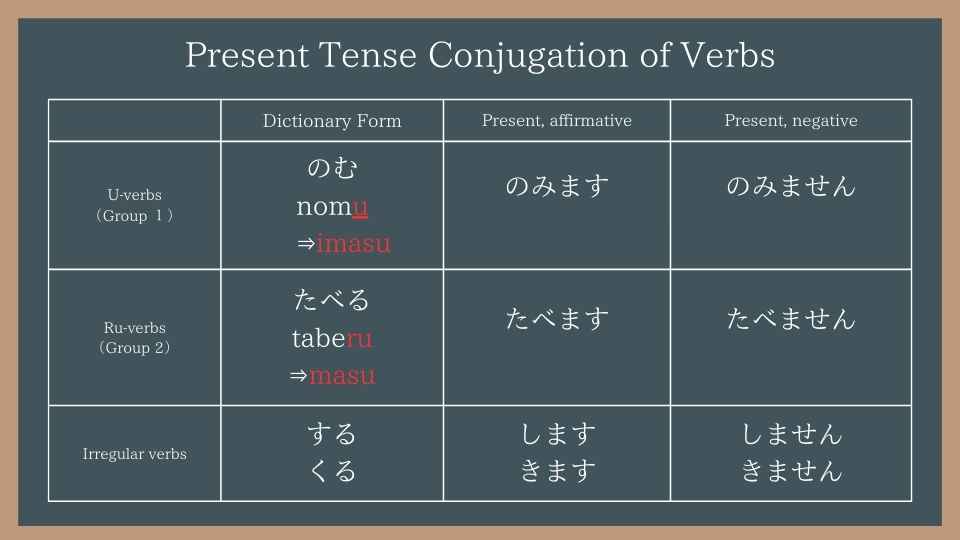
You can also make them negative by changing -masu to -masen.
たべます (tabemasu) → たべません (tabemasen)
I will eat. → I will not eat.
いきます (ikimasu) → いきません (ikimasen)
I will go. → I will not go.
How to tell if a る-ending verb is actually a う-verb
Some verbs end in る but are actually う-verbs, which means you don’t just drop the る to conjugate them. Here’s how to tell them apart.
Step 1: Look at the vowel sound before る
- If the sound before る is a / u / o → it is a う-verb.
わかる (wakaru): the vowel before る is “a” → う-verb → わかります
つくる (tsukuru): “u” → う-verb → つくります
とおる (tooru): “o” → う-verb → とおります - If the sound before る is i or e → it is probably a る-verb, but not always.
たべる (taberu): “e” → る-verb → たべます
みる (miru): “i” → る-verb → みます
Step 2: Watch out for common う-verbs that end in いる / える
A small group of verbs end in いる or える but are still う-verbs. You need to memorize these. They are exceptions to the “i / e” rule.
| Dictionary form | Meaning | Type | ます form |
|---|---|---|---|
| はしる (hashiru) | to run | う-verb ⚠️ | はしります |
| しる (shiru) | to know | う-verb ⚠️ | しります |
| きる (kiru) | to cut | う-verb ⚠️ | きります |
| かえる (kaeru) | to go home | う-verb ⚠️ | かえります |
| はいる (hairu) | to enter | う-verb ⚠️ | はいります |
| きる (kiru) | to wear | る-verb ✅ | きます |
| みる (miru) | to see / watch | る-verb ✅ | みます |
A pattern worth knowing
- Verbs ending in -aru, -uru, -oru (e.g. わかる, つくる, とおる) are always う-verbs. A る-verb must end in -iru or -eru.
- Verbs ending in -iru or -eru could be either a う-verb or a る-verb. You need to check.
At this stage the fastest approach is simply to learn each verb’s type together with its meaning. The pattern above is a useful backup check.
Particles: を、で、に、へ — side by side
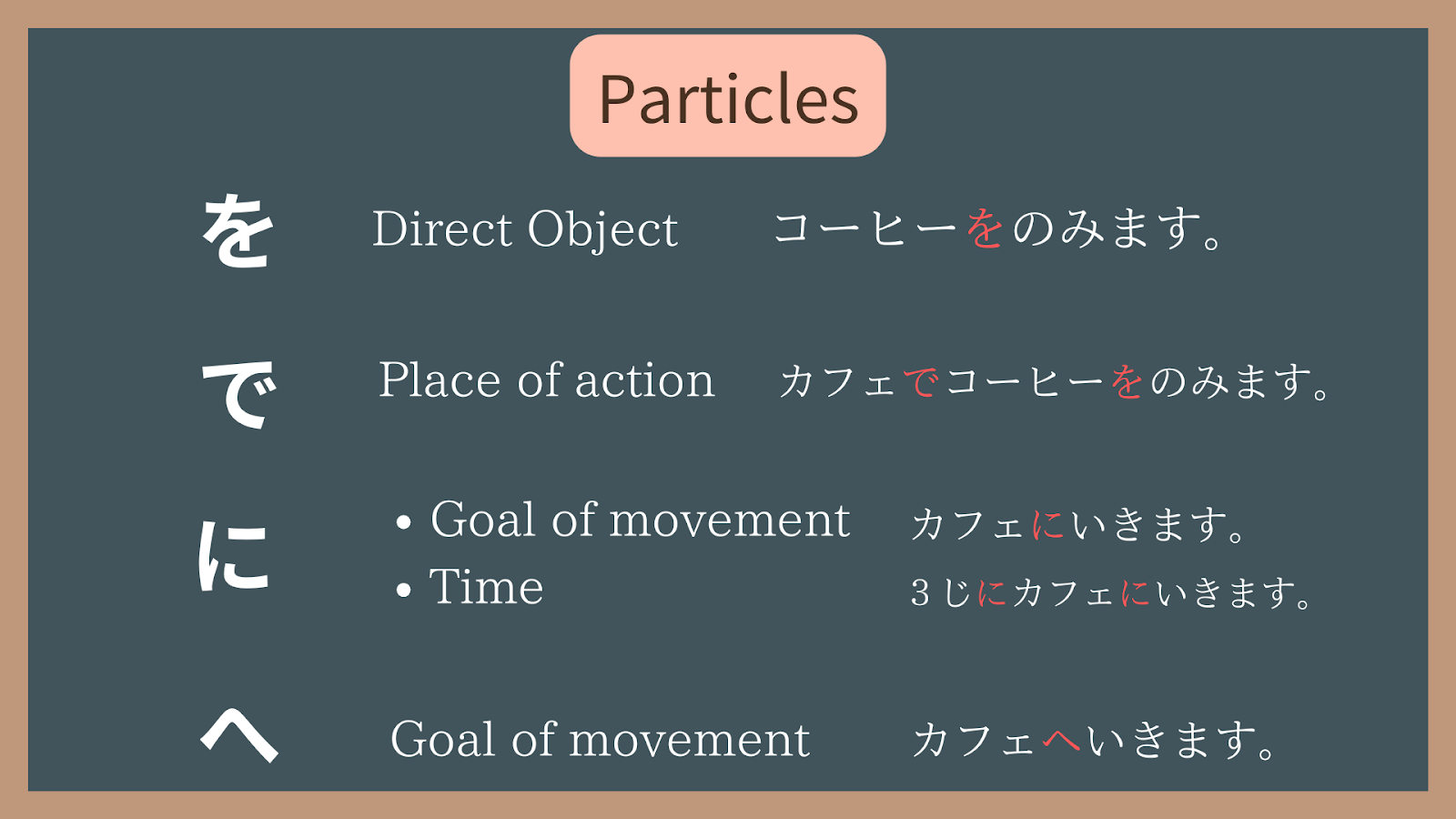
You’ve seen を、で、に、へ used in examples above. Here’s how they compare so you can choose the right one every time.
| Particle | Job | Example |
|---|---|---|
| を | Direct object: marks what the action is done to | コーヒーを 飲(の)みます。 I drink coffee. |
| で | Location of action: marks where something happens | 図書館(としょかん)で 本(ほん)を 読(よ)みます。 I read a book at the library. |
| に | Destination or time: where you’re going, or when something happens | 学校(がっこう)に 行(い)きます。 I go to school. 七時(しちじ)に 起(お)きます。 I wake up at 7. |
| へ | Direction of movement: similar to に, but emphasizes the direction rather than the destination | 東京(とうきょう)へ 行(い)きます。 I’m heading to Tokyo. |
Particles are the key to building Japanese sentences. They connect nouns to verbs and show the function of each word.
- 「を」 (o): the direct object marker
「を」 marks the direct object of a verb. It tells you what you are doing the action to.
ごはん を たべます。(gohan o tabemasu.) I eat rice. - 「で」 (de): the location of action marker
「で」 marks the place where an action occurs.
レストラン で ごはん を たべます。(resutoran de gohan o tabemasu.) I eat rice at a restaurant. - 「に」 (ni) and 「へ」 (e): the directional markers
「に」 and 「へ」 both indicate a destination or direction. They are often interchangeable, but 「へ」 has a stronger nuance of movement towards a location.
がっこう に いきます。(gakkou ni ikimasu.) / がっこう へ いきます。(gakkou e ikimasu.) I go to school.
に vs. で: the most common mix-up
に marks where you’re going (destination). で marks where an action takes place (location of activity).
- 図書館(としょかん)に 行(い)きます。→ I go to the library. (destination)
- 図書館(としょかん)で 勉強(べんきょう)します。→ I study at the library. (location of action)
に vs. へ
に and へ are often interchangeable for destinations. The difference is subtle: に is more precise (“I’m going to that specific place”), while へ emphasizes the direction of movement (“I’m heading that way”). In everyday conversation, に is more common.
The Particle「に」 for Time
The particle 「に」 is not just for places; it’s also used to specify the time an action takes place. You add 「に」 after a specific time to indicate when something happens.
- 午後(ごご: p.m.)七時(しちじ: seven o’clock)に ごはん を たべます。
I eat dinner at 7 p.m. - 毎日(まいにち: every day)九時半(くじはん: 9:30)に ねます。
I go to bed at 9:30 every day.
Important: You cannot use 「に」 with words like 今日(きょう: today), 明日(あした: tomorrow), 昨日(きのう: yesterday), 毎日(まいにち: every day), or いつ(itsu: when).
Word Order and Frequency Adverbs
In Japanese, the basic word order is Subject – Object – Verb. However, the order is very flexible because particles clearly show the function of each word.
私(わたし)は 朝(あさ) ごはん を たべます。
I eat breakfast in the morning.
You can also add frequency adverbs to say how often you do something. These usually come after the subject.
| Adverb | Meaning | Example |
|---|---|---|
| いつも (itsumo) | Always | いつも コーヒーを 飲(の)みます。 (I always drink coffee.) |
| よく (yoku) | Often | よく 映画(えいが)を 見(み)ます。 (I often watch movies.) |
| ときどき (tokidoki) | Sometimes | ときどき 本(ほん)を 読(よ)みます。 (I sometimes read books.) |
| あまり (amari) | Not often | あまり 勉強(べんきょう)しません。 (I don’t study often.) |
| ぜんぜん (zenzen) | Not at all | ぜんぜん テレビを 見(み)ません。 (I don’t watch TV at all.) |
Tip: 「あまり」 and 「ぜんぜん」 must always be used with a negative verb form (-masen).
By using these new verbs, particles, and adverbs, you can now build a wide range of sentences to talk about your life. You can describe what you do, where you go, and how often you do it!
Inviting and Suggesting
Inviting someone: 〜ませんか
You already know the negative form 〜ません (“I don’t…”). Add か at the end and it becomes an invitation: “Would you like to…?” or “Shall we…?”
- いっしょに 昼(ひる)ごはんを 食(た)べませんか。
Would you like to have lunch together? - 映画(えいが)を 見(み)ませんか。
Would you like to watch a movie? - 公園(こうえん)に 行(い)きませんか。
Shall we go to the park?
How to respond:
- ✅ いいですね! — That sounds great!
- ✅ ええ、いいですよ。 — Yes, that works for me.
- ❌ すみません、ちょっと…。 — I’m sorry, that’s a bit… (polite decline)
Suggesting together: 〜ましょう
〜ましょう is the “let’s” form. Use it to suggest doing something together, or to respond enthusiastically to a 〜ませんか invitation.
- いっしょに 食(た)べましょう!
Let’s eat together! - 日本語(にほんご)を 勉強(べんきょう)しましょう!
Let’s study Japanese! - 行(い)きましょう!
Let’s go!
〜ませんか and 〜ましょう together:
A 昼(ひる)ごはんを 食(た)べませんか。
Would you like to have lunch?
B いいですね! 食(た)べましょう!
Sounds great! Let’s eat!
Tip: Add か to make it a softer offer. 〜ましょうか means “Shall I…?” or “Shall we…?”
- 手伝(てつだ)いましょうか。
Shall I help you?